
How to combine TRT with strength training for max results

You’re on TRT, your energy is better, your mood has shifted, and you’re ready to push harder in the gym. But weeks pass and the strength gains feel underwhelming. Sound familiar? Evidence-based resistance training is still the primary driver of muscle and strength gains, even when your hormones are optimized. TRT creates the conditions for better adaptation, but it doesn’t write your program or load the bar. This guide walks you through every step, from pre-training preparation to long-term monitoring, so you can actually get what you came for.
Table of Contents
Key Takeaways
Point | Details |
Training drives gains | Even on TRT, evidence-based strength training principles are essential for results. |
Monitor health markers | Regular lab checks, including hematocrit, keep your TRT and training program safe. |
Schedule matters | Coordinate TRT timing and lifting phases for better strength and recovery outcomes. |
No shortcuts | TRT enhances your potential, but real progress requires smart effort and patience. |
Professional support | Partner with a knowledgeable medical provider to maximize performance and safety. |
What you need before combining TRT and strength training
Before you add serious lifting volume to an active TRT protocol, there are non-negotiable checkpoints. Skipping these doesn’t just slow your progress. It creates real medical risk that your training partner won’t catch and your mirror won’t show.
Start with a full lab panel. Your baseline bloodwork should include total and free testosterone, hematocrit, hemoglobin, a complete blood count (CBC), a comprehensive metabolic panel, and a lipid panel. These numbers tell your provider whether your therapy is dialed in and whether your body is ready for the added cardiovascular and metabolic demand of heavy training.

TRT side effects like elevated red blood cell production are more pronounced when you add intense exercise, which is why hematocrit monitoring is not optional. As Buffington Family Medicine notes, elevated hematocrit increases blood viscosity, raising clotting risk, and that risk compounds with high-intensity training. Most providers want your hematocrit below 54% before clearing you for heavy lifting programs.
Cardiovascular readiness matters just as much. A resting blood pressure check, a review of any cardiac symptoms, and an honest conversation with your provider about your training history are all part of this stage. The long-term safety of TRT is well-supported in the literature, but only when managed properly.
Here’s a quick overview of the pre-training checklist:
Checkpoint | Why it matters | Target range |
Hematocrit | Blood viscosity and clotting risk | Below 54% |
Total testosterone | Confirms therapy is therapeutic | 400 to 900 ng/dL |
Blood pressure | Cardiovascular safety | Below 130/80 mmHg |
CBC | Detects polycythemia early | Within normal limits |
Lipid panel | Cardiovascular baseline | Provider-reviewed |
Beyond labs, assess your physical baseline honestly. If you haven’t trained consistently in months, jumping into a five-day powerlifting split is a setup for injury, not gains. Start with movement quality, joint health, and a realistic training history review.
Confirm your TRT dose has been stable for at least 6 to 8 weeks before starting a new program
Clear any musculoskeletal issues with a physical therapist or sports medicine provider
Establish a sleep baseline, since benefits of TRT like improved sleep quality directly affect your recovery capacity
Know your resting heart rate and blood pressure so you have a comparison point later
Pro Tip: Schedule your pre-training lab work to land about two weeks before your program start date. That window gives your provider time to review results, make any TRT adjustments, and clear you for progressive loading without a rushed decision.
Step-by-step: How to combine TRT with strength training
With your labs reviewed and your provider’s clearance in hand, you’re ready to build the actual protocol. The key word here is system. Men who try to wing it, either with their training or their TRT management, consistently underperform compared to those who follow a structured sequence.
Step 1: Choose a program built on progressive overload. Progressive overload means systematically increasing the stress placed on your muscles over time, whether through more weight, more reps, shorter rest, or greater range of motion. This principle is the engine of every effective strength program. Linear progression models like Starting Strength or 5/3/1 work well for men in the early-to-intermediate stage. More advanced trainees may need block periodization, cycling through accumulation, intensification, and realization phases.
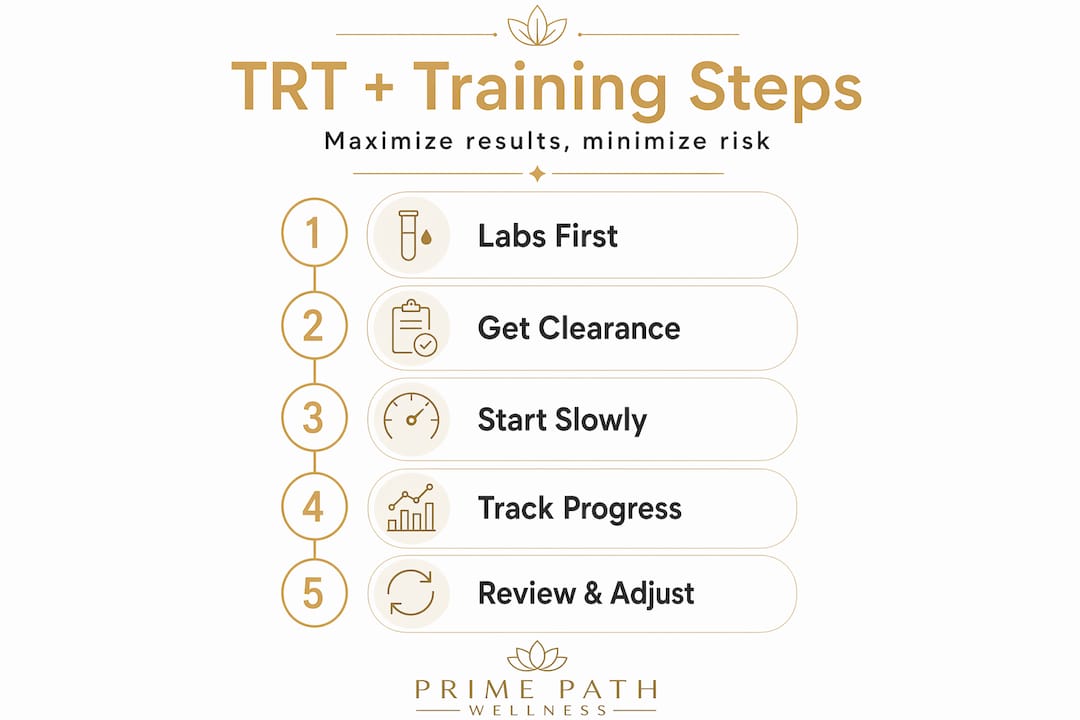
Step 2: Coordinate your TRT injection schedule with your training week. If you’re on weekly or twice-weekly injections, your testosterone peaks roughly 24 to 72 hours post-injection. Many men schedule their hardest training sessions, like heavy squats or deadlifts, to align with these peaks. This isn’t mandatory, but it’s a practical optimization that some men notice a real difference from.
Step 3: Phase your training introduction. Don’t start at full volume. Begin at 60 to 70% of your target weekly volume for the first three to four weeks. This gives your connective tissue, which adapts slower than muscle, time to catch up with the accelerated recovery your optimized hormones are enabling. Combining testosterone therapy with resistance exercise shows additive benefits for performance and lean mass, particularly when starting from a low-to-normal testosterone baseline, but only when training load is introduced progressively.
Step 4: Track recovery as carefully as you track lifts. Log your sleep quality, soreness levels, resting heart rate, and mood daily. These are your early warning signals. If your resting heart rate climbs five or more beats above baseline for three consecutive days, you’re accumulating fatigue faster than you’re recovering. That’s a deload signal, not a push-through signal.
Step 5: Schedule a check-in with your provider at the 8-week mark. By this point you’ll have performance data, recovery trends, and any subjective changes to report. Your provider can cross-reference these with updated labs to determine whether your TRT protocol needs adjustment.
Here’s how a phased approach compares to diving in all at once:
Approach | Weeks 1 to 4 | Weeks 5 to 8 | Risk level | Outcome quality |
Phased introduction | 60 to 70% volume | 85 to 100% volume | Low | High |
Full volume immediately | 100% volume | Forced deload | High | Inconsistent |
No structure | Random | Random | Very high | Poor |
Understanding how TRT compares to natural testosterone helps set realistic expectations here. You’re not operating at supraphysiological levels. You’re restoring a normal hormonal environment, which means your gains still follow the same biological rules, just from a better starting position.
Pro Tip: Use a simple training log app or even a notebook to track your top sets each week. When you can look back and see consistent progress over 12 weeks, it’s one of the most motivating data points you’ll have, and it gives your provider concrete information to work with at your next check-in.
Monitoring results and staying safe throughout your program
Once your program is running, your job shifts to two parallel tracks: pushing for performance and staying ahead of any safety signals. These aren’t in conflict. In fact, men who monitor closely tend to train harder over the long run because they catch problems early and avoid forced breaks.
What to track in the gym:
Weekly top set performance on your primary lifts (squat, deadlift, press, row)
Body weight and body composition trends, not just scale weight
Subjective energy and motivation before sessions
Recovery quality, including sleep duration and soreness patterns
What to track medically:
Hematocrit and hemoglobin every 3 months while on TRT and training
Blood pressure at least monthly, more frequently if you have any history of hypertension
Testosterone levels at 6 to 8 weeks after any dose change
Estradiol if you’re experiencing water retention, mood swings, or joint discomfort
The TRAVERSE trial provided strong reassurance that TRT does not increase major cardiovascular event rates in men with hypogonadism, which is meaningful data for men who want to train hard without worrying that their therapy is working against their heart. That said, the trial population was medically supervised, which reinforces why provider oversight is part of the safety equation, not a formality.
“Progressive overload is still required for strength and hypertrophy gains on TRT. The therapy optimizes your potential for adaptation; it doesn’t replace the training stimulus.” — ACSM position statement
Red flags that require immediate provider contact:
Hematocrit above 54%
Sudden shortness of breath during training
Chest tightness or pressure at rest or during exercise
Severe headaches or visual changes
Unexplained swelling in the legs
For Texas men using telehealth TRT, the convenience of online TRT management in Texas means you don’t need to drive to a clinic every time you need a check-in. Labs can be ordered remotely and reviewed by your provider, keeping the monitoring process efficient without cutting corners.
What to expect: Benefits, limitations, and common mistakes
Let’s be direct about what TRT actually delivers in the context of strength training, because the gap between expectation and reality is where most men get frustrated.
Realistic benefits you can expect:
Faster recovery between sessions, meaning you can handle more training frequency without the same accumulated soreness
Modestly greater strength and power output over time, particularly in compound movements
Better body composition trends, with TRT and body composition research showing consistent reductions in fat mass alongside lean mass preservation
Improved motivation and drive, which translates to training consistency
Better sleep quality, which is one of the most underrated performance enhancers available
What TRT does not do:
It does not replace a well-designed program. TRT most consistently augments strength, power, and recovery, not endurance, and results depend entirely on training quality.
It does not accelerate gains if your technique is poor, your nutrition is inadequate, or your sleep is less than 7 hours per night.
It does not protect you from overtraining. In fact, some men on TRT feel so good early on that they overtrain before their connective tissue has adapted.
Performance effects vary, and research published in PMC confirms that outcomes are most reliably positive for resistance training goals, not aerobic capacity. If you’re expecting your 5K time to drop dramatically, you’re measuring the wrong outcome.
Common mistakes that kill results:
Skipping quarterly lab checks because you feel fine
Equating TRT with instant muscle, then losing motivation when gains come at a normal pace
Neglecting program design and just “going to the gym” without structure
Ignoring nutrition, particularly protein intake, which should be at least 0.7 to 1 gram per pound of body weight daily
Not communicating training changes to your provider, who needs that context to interpret your labs accurately
If you’re still figuring out whether TRT is the right fit for your situation, that’s a conversation worth having before you build a training program around it.
The uncomfortable truth about TRT and strength: What most men misunderstand
Here’s what we see repeatedly: men start TRT, feel dramatically better within weeks, hit the gym with renewed intensity, and then plateau. They blame the therapy. They wonder if their dose is wrong. They start researching more aggressive protocols. But the real issue is almost always the training itself.
TRT acts as what researchers call a permissive modulator of muscle adaptation. It creates a more favorable environment for your body to respond to training stress. But if the training stress isn’t organized, progressive, and specific, there’s nothing for the hormonal environment to amplify. You’re optimizing a system that isn’t running a quality program.
The men who get the most out of TRT versus relying on natural testosterone over the long term are the ones who treat their training with the same seriousness as their medical protocol. They periodize. They deload. They track. They adjust based on data, not feelings.
Patience is the variable most men underestimate. Hormonal optimization takes 3 to 6 months to fully stabilize. Strength adaptations from a new program take 8 to 12 weeks to become clearly measurable. When you stack these timelines, you’re looking at a 6-month window before you have a true picture of what the combination is doing for you. Men who bail at 8 weeks never get that data.
The shortcut mindset is the biggest performance killer in this space. TRT is not a shortcut. It’s a foundation. And a foundation only matters if you build something real on top of it.
Ready to maximize your results? Our TRT and strength training support
You’ve done the reading. Now the question is whether your TRT protocol is actually optimized for what you’re trying to accomplish in the gym.

At Prime Path Wellness, we work with Texas men who are serious about getting measurable results from their TRT, not just feeling better on paper. Our TRT therapy for Texas men is fully provider-supervised, with labs ordered remotely, medications shipped to your door, and ongoing monitoring built into every protocol. If you’re ready to stop guessing and start building a program backed by real data and clinical oversight, our online TRT program is designed exactly for that. Schedule a consultation and let’s build a plan that actually matches your training goals.
Frequently asked questions
Does TRT automatically make you stronger without training?
No. TRT normalizes your hormonal environment, but training still drives muscle and strength gains. The therapy supports adaptation; it doesn’t create it independently.
How do I monitor safety while on TRT and lifting weights?
Get regular bloodwork every 3 months, focusing on hematocrit and CBC, and maintain active communication with your provider. Monitoring these markers is the standard of care for men combining TRT with resistance training.
What type of strength program works best with TRT?
A progressive resistance plan with structured volume, appropriate frequency, and planned periodization gives the best outcomes. Evidence-based resistance training maximizes the adaptation potential that TRT creates.
Is TRT safe for men who want to lift heavy?
Yes, for properly selected and monitored men. The TRAVERSE trial confirmed that TRT does not raise major cardiovascular event rates, but provider supervision remains essential for safe long-term use.
Should I expect major gains in endurance on TRT?
No. TRT primarily supports strength, power, and recovery. Research consistently shows that aerobic performance is not a primary benefit of testosterone therapy, so focus your outcome tracking on resistance training metrics.
Recommended



Comments