
How TRT changes body composition: what the evidence shows

Updated: Jun 20
Testosterone replacement therapy gets a lot of hype in men’s health circles, especially among guys in Texas who’ve hit a wall with stubborn belly fat, shrinking muscle, and energy that’s gone flat. The assumption is simple: get your testosterone up, and the fat melts off while muscle packs on. The reality is more nuanced, and understanding that nuance is what separates men who get real results from those who feel let down three months into therapy. This guide breaks down exactly what current science says about TRT and body composition, what changes you can realistically expect, and what factors actually drive those changes.
Table of Contents
Key Takeaways
Point | Details |
TRT improves lean mass | Testosterone therapy consistently increases muscle tissue in men with low testosterone. |
Fat loss varies | Fat mass reduction depends on lifestyle factors and baseline testosterone. |
Lifestyle is essential | Diet and exercise are crucial for results—TRT alone is rarely enough for dramatic change. |
Monitoring ensures safety | Clinical oversight helps manage TRT risks like blood changes or estrogen effects. |
Realistic expectations matter | Understanding what TRT can and cannot do prevents disappointment and helps long-term success. |
What does body composition really mean?
To understand how TRT makes a difference, you need to know what “body composition” truly captures. It’s not your weight on a scale. It’s the ratio of lean mass (muscle, bone, water, organs) to fat mass in your body. Two men can weigh exactly the same and look completely different because their composition differs dramatically.
How body composition is measured
The gold standard for measuring body composition is a DEXA (dual-energy X-ray absorptiometry) scan. DEXA gives you precise numbers for fat mass, lean mass, and bone density in different regions of the body. MRI is even more precise but rarely used in clinical practice due to cost. BMI, while widely used, is a blunt instrument. It tells you nothing about whether your weight comes from muscle or fat, which makes it nearly useless for tracking TRT outcomes.
Measurement method | Accuracy | Practical use | Cost |
DEXA scan | High | Clinical and research settings | Moderate |
MRI | Very high | Research only | High |
Hydrostatic weighing | High | Specialized facilities | Moderate |
BMI | Low | Population screening only | Free |
Bioelectrical impedance | Moderate | Home/gym use | Low |
Two types of fat matter most in this conversation. Visceral fat sits deep in the abdomen around your organs and is strongly linked to cardiovascular disease, insulin resistance, and metabolic dysfunction. Subcutaneous fat sits just under the skin. Men with low testosterone tend to accumulate more visceral fat, which is one reason hormone decline hits so hard metabolically. DEXA-measured body composition changes, including reductions in fat mass and increases in lean mass, have been tracked over about 12 months in clinical studies, giving us real numbers to work with.
Key facts about body composition in men:
Lean mass naturally peaks in your late 20s and declines roughly 3-8% per decade after 30
Testosterone levels drop about 1-2% per year after age 30, accelerating after 50
Low testosterone is directly associated with increased fat mass, particularly visceral fat
Maintaining lean mass matters beyond aesthetics: it supports metabolism, insulin sensitivity, and long-term mobility
Explore how TRT and body composition changes interact across different timelines and starting points to set realistic expectations before you begin.
How does TRT shift fat and muscle? The science explained
With the basics of body composition covered, let’s see exactly what happens when testosterone is reintroduced to men with low levels. The short answer: yes, TRT shifts your composition, but the magnitude depends heavily on context.

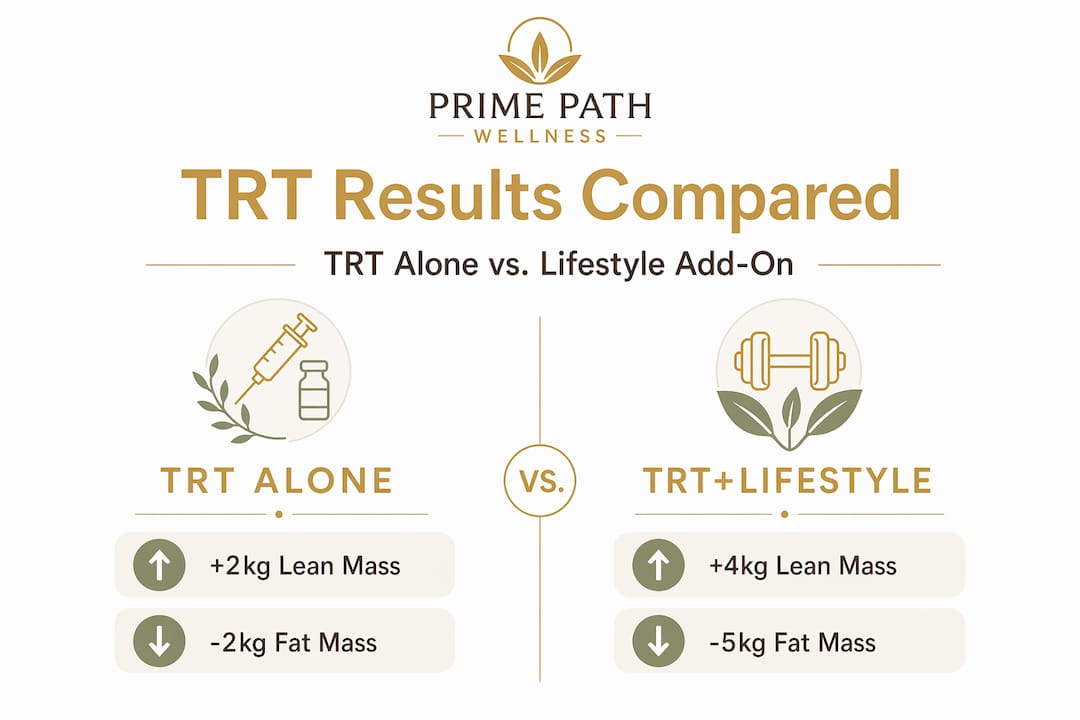
Clinical data gives us concrete numbers. In DEXA-measured trials at Day 365, men on TRT showed a fat mass reduction of approximately 2.4 kg and a lean mass increase of approximately 3.2 kg. Those numbers are meaningful, but they’re not dramatic. You’re not looking at a physique overhaul from testosterone alone.
The key mechanisms driving these changes
Androgen receptor activation in muscle: Testosterone binds to androgen receptors in skeletal muscle, stimulating protein synthesis and reducing muscle protein breakdown. This is the primary driver of lean mass gains.
Adipocyte (fat cell) regulation: Testosterone suppresses the differentiation of stem cells into fat cells and promotes fat mobilization, particularly in visceral depots.
Insulin sensitivity improvement: Higher testosterone levels improve how your cells respond to insulin, which reduces fat storage signals and improves glucose uptake in muscle.
Growth hormone axis stimulation: Testosterone indirectly boosts growth hormone and IGF-1 (insulin-like growth factor 1), both of which support muscle protein synthesis and fat metabolism.
Enhanced skeletal muscle glycolysis: TRT selectively improves the muscle’s ability to use glucose for energy, which supports performance and body composition when paired with exercise.
TRT’s effect on body composition is real but context-dependent. Men with significantly low baseline testosterone tend to see larger shifts. Men who are already in the normal range and start TRT for other reasons may see minimal compositional change.
Comparison: TRT outcomes with and without lifestyle changes
Outcome measure | TRT alone | TRT + diet and exercise |
Fat mass reduction | Modest (approx. 2 kg) | Significantly greater |
Lean mass gain | Moderate (approx. 3 kg) | Greater and sustained |
Visceral fat reduction | Moderate | More pronounced |
Metabolic markers | Mild improvement | Substantial improvement |
Bone mineral density | Preserved or improved | Preserved or improved |
Learn more about the TRT benefits for lean mass and how they extend well beyond the scale.
The power of combining TRT with lifestyle changes
If you’re hoping TRT alone is enough, it’s vital to see how lifestyle and hormones work together in the real world. The data here is both encouraging and sobering.
“TRT with lifestyle therapy preserved lean mass and hip bone mineral density, with improved metabolic and fitness outcomes compared to lifestyle therapy alone in certain measures.” — Frontiers in Endocrinology, 2025
One of the most important recent findings: adding TRT to intensive lifestyle therapy did not produce additional improvement in HbA1c (a key marker of blood sugar control) compared to lifestyle plus placebo. In other words, if you’re hoping TRT will give you a metabolic edge beyond what diet and exercise already provide, the evidence doesn’t fully support that expectation.
What TRT does add, particularly for older men in a calorie deficit, is protection of lean mass and bone density. Cutting calories aggressively without adequate testosterone often leads to muscle loss alongside fat loss. TRT helps preserve that hard-earned muscle while you’re in a deficit, which matters enormously for long-term metabolism and physical function.
Another important finding: TRT combined with lifestyle selectively enhanced skeletal muscle glycolysis at 6 months. This means your muscles become better at burning glucose for fuel, which supports both performance and body composition when you’re actually training.
Benefits of pairing TRT with diet and exercise:
Greater and more sustained fat mass reduction compared to TRT alone
Preservation of lean muscle during calorie restriction
Improved strength and exercise capacity, making workouts more productive
Better insulin sensitivity and glucose metabolism
Enhanced motivation and recovery, which supports consistency
Protection of bone mineral density, especially relevant for men over 45
Pro Tip: If you’re starting TRT, treat it as a tool that makes your lifestyle work harder, not a replacement for it. Men who pair TRT with structured resistance training and a protein-adequate diet consistently see better outcomes than those who rely on the hormone alone.
Compare the approach of TRT vs. natural testosterone optimization to understand which path fits your situation before committing to therapy. You can also review TRT in weight loss studies to see how the clinical evidence applies to real-world weight management goals.
Context, expectations, and safety: what most men miss
Knowing how changes occur is useful, but understanding the individual context and safety considerations is just as important. This is where a lot of men get tripped up, either by expecting too much or by ignoring the monitoring side of treatment.
Not every man responds to TRT the same way. Your baseline testosterone level matters enormously. A man with a total testosterone of 180 ng/dL will likely see more dramatic compositional changes than a man at 380 ng/dL. Age, body fat percentage, sleep quality, stress levels, and diet all interact with how your body responds to exogenous testosterone.
TRT’s effects are not guaranteed to translate into additional cardiometabolic benefits and could potentially blunt some benefits induced by lifestyle therapy in certain populations. This is a nuanced finding that deserves attention. It doesn’t mean TRT is harmful. It means that in some men, particularly those with borderline low testosterone and good lifestyle habits, the added benefit may be smaller than expected.
Safety and monitoring: what you need to track
Monitoring and risk mitigation are crucial for managing TRT-associated risks. The key markers to watch include:
Hematocrit: TRT stimulates red blood cell production. Elevated hematocrit increases clotting risk and needs to be managed with dose adjustments or therapeutic phlebotomy
Estradiol (estrogen): Testosterone converts to estrogen via aromatase. High estrogen can cause water retention, mood changes, and reduced libido
PSA (prostate-specific antigen): Monitored for prostate health, especially in men over 40
Lipid panel: Some forms of TRT can affect cholesterol levels, particularly HDL
Liver enzymes: Relevant for oral testosterone formulations
Total and free testosterone: To ensure you’re in a therapeutic range, not supraphysiologic
Pro Tip: Never skip your follow-up bloodwork. Men who monitor consistently are the ones who stay on therapy safely and get the best long-term results. Labs every 3-6 months during the first year of TRT is a reasonable standard.
For a thorough look at the long-term picture, review what the science says about TRT safety long-term and get familiar with the full list of TRT side effects before starting therapy.
The uncomfortable truth: why lifestyle is the real foundation, and what TRT actually delivers
Here’s the perspective most men don’t want to hear but need to: testosterone therapy is a powerful clinical tool, and it genuinely works. But it is not a shortcut. It never was.
We see men come in frustrated after 90 days on TRT because they haven’t lost 20 pounds. When you dig into their habits, the diet is still inconsistent, the training is sporadic, and sleep is four to six hours a night. TRT cannot overcome a lifestyle that undermines it. The hormone optimizes the environment inside your body. It does not build the house for you.
The men who get the most out of TRT are the ones who were already doing the work and hit a ceiling. They’re training consistently, eating enough protein, sleeping well, and still watching muscle decline and fat accumulate. For those men, TRT can be genuinely transformative because the foundational work is already in place.
There’s also a psychological trap worth naming. When men expect dramatic fat loss from TRT and don’t see it, they sometimes abandon the therapy entirely, missing the real benefits: better energy, improved mood, stronger recovery, and preserved lean mass over time. These are meaningful health benefits of TRT that don’t always show up on the scale but dramatically improve quality of life.
A practical framework for men considering TRT:
Get comprehensive labs first. Know your baseline testosterone, estradiol, metabolic markers, and thyroid function.
Audit your lifestyle honestly. Sleep, training, nutrition, and stress management should be addressed before or alongside TRT.
Set a realistic 12-month timeline. Body composition changes from TRT are gradual and cumulative.
Work with a provider who monitors you, not just prescribes to you.
Evaluate results at 6 and 12 months with objective measurements, ideally a DEXA scan, not just how you feel.
TRT is a serious medical therapy with real benefits and real risks. Treat it that way, and it can be one of the most effective tools in your health arsenal.
Considering TRT in Texas? Where to go from here
If you’re ready to take action and explore TRT as part of your body composition journey, here’s what to do next.
Texas men now have access to high-quality, physician-supervised TRT without the hassle of in-person clinic visits. At Prime Path Wellness, every protocol is built around your specific labs, goals, and health history. Nothing is one-size-fits-all.

Whether you’re dealing with stubborn visceral fat, declining muscle despite consistent training, or energy that just won’t recover, the right starting point is a clinical evaluation. Explore medically supervised TRT in Texas to understand your options and what a proper protocol looks like. If convenience matters to you, online TRT care through Prime Path Wellness means labs and medications come to you, with provider support built in every step of the way. The next move is a conversation with a provider who takes your goals seriously.
Frequently asked questions
How quickly does TRT change body composition?
Most men notice meaningful shifts in lean mass and fat mass within 3 to 6 months, with the most significant changes typically measured at the 12-month mark. DEXA-measured outcomes at Day 365 show an average fat mass reduction and lean mass increase that become clinically significant over time.
Does TRT cause weight loss or just muscle gain?
TRT typically reduces fat mass and increases lean muscle simultaneously, but overall scale weight may not change dramatically. The effect on fat and lean mass is context-dependent and varies based on lifestyle, starting body fat, and baseline testosterone levels.
Is TRT safe for weight loss or body composition goals?
TRT can be safe and effective when properly monitored by a qualified provider. Risk mitigation and ongoing monitoring for hematocrit, estrogen, and other markers are essential to keeping therapy both safe and effective over the long term.
Will adding TRT to a healthy lifestyle improve my cardiometabolic health more?
Not necessarily. Evidence shows that adding TRT to lifestyle therapy did not provide additional improvement in HbA1c compared to lifestyle plus placebo, meaning lifestyle remains the primary driver of metabolic health.
Can I just use TRT to “melt” stubborn belly fat?
No. TRT alone does not selectively eliminate stubborn fat. TRT’s compositional benefits are most pronounced when combined with consistent diet and exercise, not as a standalone fat-loss strategy.
Recommended



Comments